When India’s Union Law Minister describes retired judges in a rather harsh manner, it is something that cannot be taken lightly. For the Minister to label retired judges who question “state policies” as being “anti-India” elements is not just a case of a flawed understanding of concepts but also a matter of grave concern for citizens.
The Minister’s parting shot, based on the erroneous assumption that certain judges are working against India and “will have to pay the price”, was not only intimidatory in its tone and tenor but also portends grave danger for the future. Involving retired judges in the issue was uncalled for. The Minister’s statements are defamatory and raise larger issues that touch the core of our polity.
A right to free speech
Judges who demit judicial office do not cease to be citizens of this country. They have not bartered away their fundamental rights for the pension they draw. They have a right to free speech and expression and a duty to speak up when they find the legislature, the executive or even the judiciary to be transgressing their limits.
The act of questioning the state is not a case of being “anti-national”. It is a case of being a “concerned patriot”. In turn, the response of the state has to be to either justify the measures it has adopted, or take the advice offered and course correct. Free speech must result in more speech and not in veiled sweeping statements.
The remarks made will not scare those who are bold and the courageous who will continue to speak their mind. But the “chilling effect” from the remarks made will be felt by the rest of the citizenry.
As a result, the marketplace for ideas will be thinly populated. There will be fewer symposia on issues of seminal importance as there could be a tendency from now on to play it safe (the Minister spoke about a seminar where judges and senior advocates were the participants and where the topic was on ‘Accountability in Judges Appointment’; but, according to him, the discussion was about ‘how the government was taking over the Indian judiciary’). There could be fear as no less a person than the Minister for Law and Justice has talked about having to “pay the price” if the line (that has embedded in it concepts of government and the nation as one), drawn by him, is breached.
The deleterious effect of all this will be felt only by the nation. Actions of the state will be unchecked not because these acts are constitutional and valid, but for the reason that the mere act of questioning them will endanger the individual. He or she is held in terrorem, for they have ‘been told’ that they will have to “pay the price” if their conduct does not meet with the executive’s approval.
Indispensable freedoms
The powerful words of Justice Louis D. Brandeis that were uttered nearly a century ago, in Whitney vs California are apt: “Those who won our independence believed that the final end of the state was to make men free to develop their faculties; and that in its government the deliberative forces should prevail over the arbitrary. They valued liberty both as an end and as a means. They believed liberty to be the secret of happiness and courage to be the secret of liberty. They believed that freedom to think as you will and to speak as you think are means indispensable to the discovery and spread of political truth; that without free speech and assembly discussion would be futile; that with them, discussion affords ordinarily adequate protection against the dissemination of noxious doctrine; that the greatest menace to freedom is an inert people; that public discussion is a political duty....”
Misdirected ideas can harm the judiciary
Leading jurists have spoken about how the problem was not really about free speech, but freedom after the speech. The Minister’s statement only reinforces that theory. If this is the plight of retired judges, one shudders to think what it would be like for the ordinary citizen, namely, ‘the baker, the butcher and the candle stick maker’.
In her address to the Supreme Court of India in November 2022, the President of India, Droupadi Murmu, raised the issue of the plight of undertrials in the prisons of India, despite getting bail. The President narrated her experience of meeting undertrial prisoners when she was a Member of the Legislative Assembly in Odisha, and later as the Governor of Jharkhand. It was a speech that moved the Court, which directed jail authorities to submit the details of such prisoners to the State governments concerned which in turn were to forward the documents to the National Legal Services Authority within 15 days. Had the President kept quiet, for fear that she may have to “pay the price””, things would never have moved.
Looking ahead
It is reasonable to expect that the Prime Minister, a powerful orator and a vocal critic of many of the policies of the previous government, would certainly not want his government to be associated with such a chilling statement made by his Law Minister.
It will also be reasonable to hope and expect that the two high constitutional dignitaries will now discuss this issue and ensure that any further damage to India’s constitutional ethos is mitigated. It is only then that the message will be clear: that in India, silence will never be coerced by law. Or by the Law Minister.
K.V. Viswanathan is Senior Advocate, Supreme Court of India and a former Additional Solicitor General of India.
The article was originally published in 'The Hindu' on March 25.
https://www.livelaw.in/columns/questioning-state-not-anti-national-kv-viswanathan-writes-about-law-ministers-comments-225233
'Criticism Of Govt Not Anti-India' : Lawyers Condemn Law Minister Kiren Rijiju's Comment Against Retired Judges

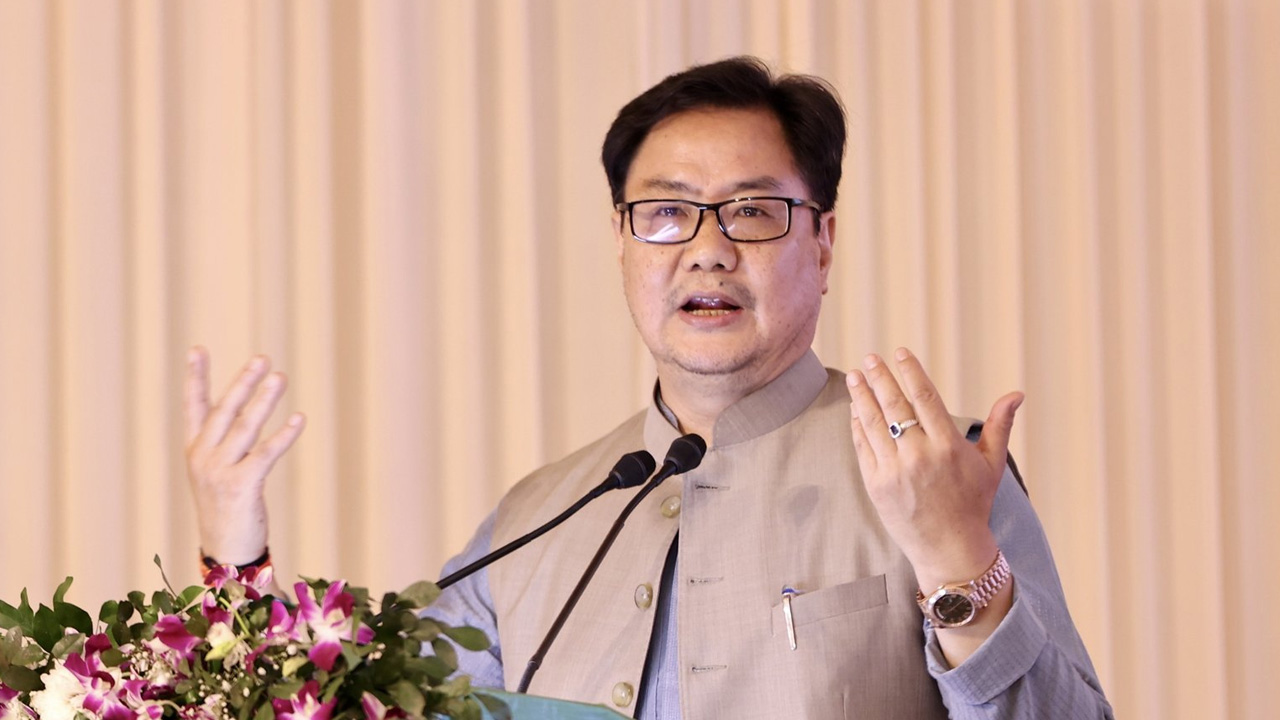
Over 300 lawyers from the Supreme Court and various High Courts have issued a statement condemning the comment of Union Law Minister Kiren Rijiju that "some retired judges belong to anti-India gang".
Taking strong objection to the Minister's comment, the lawyers said : "We may remind the Minister that criticism of the government is neither against the nation, nor unpatriotic, nor “anti-India”. The signatories of the statement added that by threatening retired judges, the Law Minister is clearly sending a message to every citizen, that no voice of dissent will be spared.
The lawyers asserted that that critics of the government are every bit as patriotic as those in government; and critics who highlight failures or shortcomings in the administration, or violations of constitutional norms, are exercising an inherent & most basic human right.
"Such hectoring and bullying are unbecoming of the high office held by the Minister", they said.
The lawyers' statement can be read here
We, the undersigned lawyers practicing in diverse courts around the nation, deprecate the unwarranted attack launched against retired judges of the Supreme Court of India by Union Law Minister Shri Kiren Rijiju, at a conclave telecast live by a media house. The allegations of anti-nationalism against people who have dedicated their lives to upholding the rule of law, and the naked threat of reprisals against them, marks a new low in the public discourse of our great nation.
We are compelled to remind Shri Rijiju that as a Member of Parliament, he is sworn to uphold and bear true faith and allegiance to the Constitution of India, and as Minister of Law and Justice, it is his duty to protect the judicial system, the judiciary and the judges, both past and present. It is no part of his duty to single out some retired judges with whose opinion he might disagree, and to issue public threats of action by law enforcement agencies against them.
The Hon'ble Minister, in his speech on March 18, 2023 obliquely referred to a “few retired judges”, who till recently occupied high Constitutional offices, as being part of an “anti-India gang.” By bracketing the critics, that too without naming them, as an anti-India gang the Minister has transgressed all limits of constitutional propriety by claiming that the members of this
‘anti-India gang’ wanted to “make the judiciary play the role of the opposition.” He pointedly threatened these retired Supreme Court judges that “no one will escape” and “those who work against the country will pay the price.”
By threatening retired judges, the Law Minister is clearly sending a message to every citizen, that no voice of dissent will be spared.
We condemn these remarks in unambiguous terms. Such hectoring and bullying are unbecoming of the high office held by the Minister. We may remind the Minister that criticism of the government is neither against the nation, nor unpatriotic, nor “anti-India”. He must remember that the government of the day is not the nation, and the nation is not the government. And of course, he will do well to remind himself of what Prime Minister Modi said on Network18 in September 2016, and again in his reply to the Motion of Thanks to President Smt. Draupadi Murmu on the floor of the Lok Sabha a couple of months ago: that the toughest questions and criticism must be levelled against governments, as that is the only way in which governments are kept alert and responsive. We unhesitatingly state that critics of the government are every bit as patriotic as those in government; and critics who highlight failures or shortcomings in the administration, or violations of constitutional norms, are exercising an inherent and most basic human right, and one which his Ministry is charged with protecting, freedom of speech and expression.
Under our Constitutional scheme, the space for criticism of the government is neither reserved for exercise in parliament or legislatures alone, nor is it confined to any particular class of persons or barred to any other. The right of every citizen to dissent, criticise and peacefully oppose any government and its policies or functioning is an inherent basic human right, which is also Constitutionally protected. Criticism of the government does not authorize a high state functionary to besmirch any individual’s patriotism.
Views expressed by former Judges, responsible women and men who have shepherded the courts through thick and thin, even if such views be unpalatable to the ruling political dispensation, does not entitle the Minister to make such outrageous comments. These unacceptable threats meted out against retired judges, have the effect of inciting the public against our judges and judicial system and deserve to be strongly condemned.
The nation owes a debt of gratitude to our retired Judges, and it matters not whether one might individually agree or disagree with the views of an individual judge, whether serving or retired.
The Hon'ble Law Minister cannot fail to recall the words attributed to Voltaire, and to remind himself that a Law Minister, more than any other, must unfailingly stand up for those words:
"I disagree with what you say, but I will defend to the death your right to say it".
The Hon'ble Minister must realise that by virtue of his office, he is the bridge between the executive and judicial wings of the state, and that he must therefore maintain a dignified public discourse.
We therefore urge the Minister to publicly withdraw his remarks and refrain from making such remarks in the future.
Signatories To The Response By Lawyers To The Law Minister's Speech Dated March 18, 2023 :

അഭിപ്രായങ്ങളൊന്നുമില്ല:
ഒരു അഭിപ്രായം പോസ്റ്റ് ചെയ്യൂ