2023 മാർച്ച് 6, തിങ്കളാഴ്‌ച

In the age of fake news, we need journalists more than ever to document the unseen and expose the fault lines in our society: Justice Chandrachud

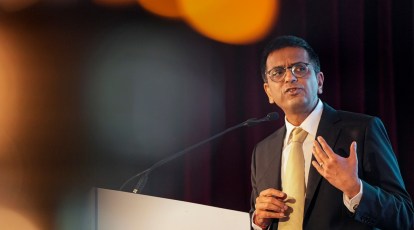
“In the age of fake news and disinformation, we need journalists more than ever to document the unseen and expose the fault lines in our society”, Justice D. Y. Chandrachud has remarked, reports Live Law.

The Supreme Court judge was delivering his address at the 11th Convocation and Founder’s Day Ceremony at the O. P. Jindal Global University.

After being affected with Covid twice in one year, I always ask myself one question every night before I end my day and that question is that if this indeed was to be the last day of my life, have I done something little today to transform, not just my loved ones, but those around me, possibly even those who I have never met. Even 75 years after Independence, many communities in India are effectively waiting to test the fruits of democracy which was inherited by us because of our hierarchical social and economic structure. Many of our citizens are deprived of equality in social and economic spheres. Dr. B. R. Ambedkar warned us that our structures of political democracy are precarious until they are not supported by social democracy. He defined social democracy as a way of life which recognises liberty, equality and fraternity as the principles of life. But it is not just the responsibility of the government or of the judiciary to promote social democracy and social justice. The branch of the State to which I belong, the judiciary, has a vital role to play in fostering social democratic values. However, the quest for a constitutional culture is not limited to courtrooms or to the black letter of the law. It exists in all of us. When Benjamin Franklin was leaving the Constitutional Convention in 1787, a woman accosted him and asked about the type of government the Constitutional Convention had deliberated upon. He replied, ‘A republic, if you can keep it”. His reply is prescient for all of us in India today. Our constitutional culture does not maintain itself, it is for each one of us as citizens to participate in the slow but vital task every day of transforming our Constitution from a charter of ideas to a reflection of reality”, continued the judge 


The realisation of those values begins at home in the lives of each one of you. As citizens, we hold the responsibility and the duty which accompanies it as inheritors and guardians of our Constitution to imbibe and to inculcate constitutional ideals into our daily lives, to promote social harmony, inclusion and plurality. It ought to be regarded as a constitutional duty. It is even a moral obligation. As all of you are in true sense a representative of a new India, as you exit the hallowed halls of your university, you should introspect how your actions could contribute to strengthening the constitutional ethos of social democracy in India. Social democracy is not a form of government but a medium to secure social justice. Social justice in turn ensures that equal social and economic opportunities are available to all the people in our society regardless of religion, race, caste, sex, gender, place of birth, or sexual orientation. Our laws provide for formal equality of opportunity. However in reality we live in an asymmetrical world where opportunities are unequally distributed. Such opportunities open many doors for the ‘haves’ but shut the doors for the ‘have nots’. In our quest for social justice, we must strive to provide equal opportunity to persons especially from marginalised backgrounds to empower them to effectively enjoy their own sense of liberty. As you enter into the next stage of your life where many of you will undertake different professional responsibilities, as lawyers, journalists, as policymakers, as economics, as academicians, as entrepreneurs and business managers, I exhorted you to contribute towards strengthening democratic structures in India and across the globe in your own meaningful way. I understand that all of you have evolved from different circumstances, you have your dreams to realise and responsibilities to discharge. A small contribution on your part will create a big difference in someone else’s life. In doing so, you elevate your own sense of being”, canvassed Justice Chandrachud. 

https://lagatar24.com/in-the-age-of-fake-news-we-need-journalists-more-than-ever-to-document-the-unseen-and-expose-the-fault-lines-in-our-society-justice-chandrachud/113626/ 


Truth has become victim in age of false news: CJI Chandrachud 

For every little thing that we do, and believe me, as judges we are no exception to this, for everything that you do, you face the threat of being trolled by someone who does not share your point of view," the CJI said. (PTI) 

Chief Justice of India D Y Chandrachud said the Supreme Court of India is not the apex court of Tilak Marg at New Delhi but it represents the aspirations of citizens in the smallest villages in the country 


Truth has become victim in age of false news: CJI Chandrachud

CJI DY Chandrachud"For every little thing that we do, and believe me, as judges we are no exception to this, for everything that you do, you face the threat of being trolled by someone who does not share your point of view," the CJI said. (PTI)

Chief Justice of India D Y Chandrachud said the Supreme Court of India is not the apex court of Tilak Marg at New Delhi but it represents the aspirations of citizens in the smallest villages in the country

Chief Justice of India D Y Chandrachud on Friday said truth has become a “victim” in the age of false news and with the spread of social media, something which is said as a seed germinates into virtually a whole theory that can never be tested on the anvil of rational science.

The CJI said today we live in an age where people are short on their patience and tolerance because they are not willing to accept perspectives which are different from their own. 

Justice Chandrachud was speaking at the American Bar Association India Conference 2023 here on the theme “Law in the age of Globalisation: Convergence of India and the West”.

The CJI spoke about a range of issues, including technology and its use by the judiciary, especially during the COVID-19 pandemic, issues confronting the judicial profession and on having more women judges. 


Truth has become victim in age of false news: CJI Chandrachud

CJI DY Chandrachud"For every little thing that we do, and believe me, as judges we are no exception to this, for everything that you do, you face the threat of being trolled by someone who does not share your point of view," the CJI said. (PTI)

Chief Justice of India D Y Chandrachud said the Supreme Court of India is not the apex court of Tilak Marg at New Delhi but it represents the aspirations of citizens in the smallest villages in the country


Chief Justice of India D Y Chandrachud on Friday said truth has become a “victim” in the age of false news and with the spread of social media, something which is said as a seed germinates into virtually a whole theory that can never be tested on the anvil of rational science.

The CJI said today we live in an age where people are short on their patience and tolerance because they are not willing to accept perspectives which are different from their own.

The CJI spoke about a range of issues, including technology and its use by the judiciary, especially during the COVID-19 pandemic, issues confronting the judicial profession and on having more women judges.


Justice Chandrachud said in many ways, the Indian Constitution is a prime example of globalisation even before we ventured into the age of globalisation.

He said when the Constitution was drafted, its makers had possibly no idea of the lines along which humanity would evolve. 

We did not possess notions of privacy, there was no internet. We did not live in a world which was controlled by algorithms. We certainly did not have a social media,” he said. 

For every little thing that we do, and believe me, as judges we are no exception to this, for everything that you do, you face the threat of being trolled by someone who does not share your point of view,” the CJI said.

He said just as humanity has expanded with the global advent of travel and technology, humanity also has retreated within by not willing to accept anything that people, as individuals, believe in.

“And I believe that is the challenge of our age. Some of this is perhaps the product of technology itself,” he said, while also dwelling on the positives of technology. 

Speaking about the time when COVID-19 had spread across the world, including India, the CJI said the Indian judiciary started video-conferencing in a very gentle way and then expanded it across all courts.

“What video-conferencing has done as a consequence of pandemic is that it has led to a decentralisation of justice. And I think this decentralisation of justice is an important paradigm in promoting greater access to justice,” he said.

He said the Supreme Court of India is not the apex court of Tilak Marg at New Delhi but it represents the aspirations of citizens in the smallest villages in the country.

“And what better way to reach out to our citizens than to use technology as a part of our mission to take justice to the doorsteps of citizens,” he said.

“But, apart from technology, there are vital issues which confront the profession today. Chief among them is the reform of the legal profession itself. In so many ways, our profession is still patriarchal, our profession is feudal, our profession is built upon kinships and relationships of community,” he said. 

Justice Chandrachud said globalisation has led to its own discontent and there are a number of reasons for this, for the meltdown which has been experienced the world over.

“One, I think the first of the origins of this lay in the terror attacks which took place in 2001. India was shaken up sporadically by these terror attacks… But 2001 was a watershed moment which brought to the global society the stark realities which India had already confronted for years and years before that,” he said. 

The CJI said he is often asked about why we cannot have more women judges in the country.

He said the state of our institution today in terms of inclusion and diversity reflects the state of the profession two decades ago. 

Because the judges who come to the high courts today, say in 2023, or judges who come to the Supreme Court in 2023 reflect the state of the bar in the beginning of the millennium,” he said.

Justice Chandrachud said unless there was a level-playing field for women to enter and thrive in the legal profession between 2000 and 2023, there is no magic wand by which you will have apex court judges drawn from among women in 2023.

“So we have to create a framework, a groundwork for a more diverse and inclusive profession today if we truly have to create a future where our profession will be more inclusive and diverse,” he said.

The CJI said the statistics on recent recruitment in the district judiciary in India indicates that in many states, more than 50 per cent are women.

He said the cause of that is the spread of education in India.

“As education spread in India, women education has gone up and there is today a perception on the part of middle class, the growing middle class in India, that the key to prosperity of an average Indian family is to educate their daughters,” he said. 

The CJI also gave details of how the Supreme Court has adopted technology, including live-streaming of proceedings of the constitution benches and translation of judgements in regional languages 

https://indianexpress.com/article/india/truth-victim-in-age-of-false-news-cji-chandrachud-8478773/

2023 മാർച്ച് 3, വെള്ളിയാഴ്‌ച

Telangana govt. moves SC as Governor delays nod to Bills

Telangana govt. moves SC as Governor delays nod to Bills
The State government says it is constrained to move the top court under its extraordinary jurisdiction conferred under Article 32.
State says several Bills passed by two Houses of the State Legislature have been pending since September 14, 2022; takes legal recourse for resolving its grievance against institution of Governor
M. RAJEEV  HYDERABAD
The Telangana government has taken legal recourse for resolving its grievance against the delays in clearance of important Bills, passed by two Houses of the State Legislature, by the institution of the Governor.

The government has filed a petition in the Supreme Court claiming that the Telangana government is constrained to move before the court under its extraordinary jurisdiction conferred under Article 32 of the Constitution of India in view of “a very prequent constitutional impasse created on account of the refusal of the Governor to act on several Bills passed by the State Legislature. These Bills are pending since September 14, 2022 till date for the assent of the Governor”, the government said in its petition for which the Governor Tamilisai Soundararajan has been made a respondent.

The government in its petition attached copies of the Bills and the list of dates on which the Bills were passed by the Legislature.

The government has quoted Article 200 of the Constitution which mandates that the Governor could assent or could withhold assent in which case the Bill should be returned together with the message requesting that the Houses reconsider the Bill for any specified provision and would consider the desirability of introducing any such amendments as it might recommend in the message. By virtue of Article 163, the Governor was required to exercise his functions or any of them in his discretion only on the aid and advice of the Council of Ministers with the Chief Minister as its head.

“The Governor is not expected to act independently and this position has been made amply clear by the Constitution Bench of the Supreme Court in Shamsher Singh Vs State of Punjab (1974)”, the government said.

2023 മാർച്ച് 2, വ്യാഴാഴ്‌ച

High Courts Must Maintain 'Hands Off' Approach In Corruption Cases At Investigation Stage Even If Strong-Arm Tactics Of New Govt Suspected: Supreme Co


.

In a notable judgment, the Supreme Court has opined that it is desirable that the High Courts do not quash corruption case FIRs at investigation stage, even if it is suspected that the case has been registered by a new government against officers of the previous government.

A Bench of Justices S Ravindra Bhat and Dipankar Datta observed that if the accused are allowed to go scot-free only on the ground that the action has been taken by the current regime in a malafide manner to "settle scores", criminal justice system will become a casualty. Quashing FIR on the sole ground that it has been registered by the new government to wreak vengeance of the individual therefore is not advisable.

"This is because, it is difficult to form an opinion conclusively at the stage of reading a first information report that the public servant is either in or not in possession of property disproportionate to the known sources of his/her income. It would all depend on what is ultimately unearthed after the investigation is complete", the bench explained.

Hence, the bench said that it is desirable that the High Courts adopt a "hands-off" approach.

“Having regard to what we have observed above in paragraph 49 (supra) and to maintain probity in the system of governance as well as to ensure that societal pollutants are weeded out at the earliest, it would be eminently desirable if the high courts maintain a hands-off approach and not quash a first information report pertaining to “corruption” cases, specially at the stage of investigation, even though certain elements of strong-arm tactics of the ruling dispensation might be discernible.”

The Apex Court clarified that it does not intend to fetter the high courts from intervening in appropriate cases but sought to remind the latter to be careful, circumspect and cautious in quashing FIRs on malafide grounds.

HC Wrong To Quash FIR: State, Complainant Argue

The court made the observations in a case challenging the Chhattisgarh High Court's order quashing a disproportionate assets case registered in 2020 against Aman Singh, the former Principal Secretary of the former Chief Minister Raman Singh, and his wife Yasmin Singh, who was a consultant when the Raman Singh government was in power.

Complaints were lodged against the IRS officer and his wife in 2019 on grounds of corruption and money laundering. This apart, the couple also held assets which are disproportionate to their known sources of income, it was alleged.  The current Chief Minister Bhupesh Baghel ordered for the complaint to be enquired into by the Economic Offences Wing and consequently, a preliminary inquiry was ordered.

Prior to this, Yasmin had moved the High Court questioning the departmental enquiry. On January 16, 2020, the High Court directed the State to refrain from taking any steps to her prejudice. Then, Aman approached the High Court. While the matter was pending, an FIR was registered against the husband-wife duo.

In January, 2022, the High Court quashed the FIR. Challenging this judgement, petitions were moved before the Supreme Court.

Senior Advocate Kapil Sibal, for the State, contended that the High Court had committed gross error of law in quashing the FIR, by transgressing the legal bounds.

When a FIR could be lodged on the basis of suspicion, the High Court in the present case erred in law in quashing the FIR on the ground that it was based on “probabilities”; the High Court overstepped its limits, he argued.

Senior Advocate Sanjay Hegde, assisted by Advocate-on-Record Pranjal Kishore, for the other appellant contended that the High Court clearly applied a wrong test while quashing the FIR.

Senior Advocate Mahesh Jethmalani appearing for the couple, opposed the appeals and contended that the High Court rightly concluded that investigation of the FIR, which did not prima facie disclose commission of any cognizable offence by either of the two.

Law Abhors Illicit Intentional Enrichment; Preliminary Enquiry Indispensable: Court

The most crucial aspect for Court’s consideration was the extent of the High Courts’ power under Article 226 of the Constitution or section 482 of the Code of Criminal Procedure to quash a FIR under section 13 of the PC Act [criminal misconduct].

Highlighting the menace of corruption and greed, the Court observed that husband-wife duo are ‘public servants’ under the PC Act.

The Court noted that the illicit ‘intentional enrichment’ by a public servant during the period of their office is a criminal misconduct.

This presumptive finding, the Court said, is based on three aspects:

  • Being a public servant;
  • if at any time during the period of their office, they have been in possession, by their self or through any person on their behalf, of pecuniary resources or property disproportionate to their known sources of income,
  • they are enjoined to satisfactorily account for the same.

The offence of criminal misconduct is committed by a public servant if the second point is proved and third point does not happen, the court observed.

“The law of the land abhors any public servant to intentionally enrich himself illicitly during the tenure of his service. Increase in the assets of such a public servant tantamount to constitutionally impermissible conduct and such conduct is liable to be put under the scanner of the P.C. Act,” the court observed.

The court further observed that a preliminary inquiry or probe becomes indispensable in a complaint of acquisition of disproportionate assets not only to safeguard the interest of the accused public servant but also to appropriately assess the quantum of disproportionate assets if there’s some substance in the complaint.

The Court also voiced that during the tenure of the public servant’s office under their employer, former might not have been suspected of possession of pecuniary resources or disproportionate assets. It might been held through somebody on their behalf. This is where the importance of an investigation comes in, the court pointed out.

“In such a scenario, it is indeed a difficult task for the Government - the employer - because of its impersonal character and the usual lethargy or indolence at Government levels to connect the officer with the resources or assets illicitly acquired. To weed out corrupt public servants, the Government has to engage sincere and dedicated personnel for collecting and collating the necessary material in this regard. If there be no interventions, the investigation that is likely to follow in terms of the Cr. P.C., could enable the investigating officer to collect and collate the entire evidence establishing the essential links between the public servant and the property or pecuniary resources in dispute.”

Since snapping of any link in the chain of circumstances could prove fatal to the whole exercise, it is of utmost necessity that care and dexterity are not compromised, the court added.

Observing that the FIR in the present case could have been drafted better, the court said nothing significant turns on the "inept drafting" of the FIR "since it does make out a case of cognizable offence having been committed by AS and YS." 

Unable to appreciate the reasons for quashing the FIR, the court observed that High Court did not bear in mind the note of caution in State of Haryana Vs. Bhajan Lal’s case that the power of quashing a criminal proceeding should be exercised very sparingly and with circumspection and that too, in the rarest of rare cases.

“…the court will not be justified in embarking upon an enquiry as to the reliability or genuineness or otherwise of the allegations made in the FIR or the complaint; and also, that, the extraordinary or inherent powers do not confer an arbitrary jurisdiction on the court to act according to its whim or caprice.”

The High Court ought to have realized that the FIR which, according to it, was based on “probabilities”, ought not to have been interdicted, the court said.

On the question whether the challenge to the FIR on the ground that it is vitiated by mala fides, the Court observed that writ petitions before the High Court would not have succeeded even though that argument was advanced.

“…what is of substantial importance is that if criminal prosecution is based upon adequate evidence and the same is otherwise justifiable, it does not become vitiated on account of significant political overtones and mala fide motives. We can say without fear of contradiction, it is not in all cases in our country that an individual, who is accused of acts of omission/commission punishable under the P.C. Act but has the blessings of the ruling dispensation, is booked by the police and made to face prosecution.”

While making these observations, the court also stated that there are still innocent public officers who are roped into false cases but that would be a small price to pay.

“We quite appreciate that there could be cases of innocent public servants being entangled in investigations arising out of motivated complaints and the consequent mental agony, emotional pain and social stigma that they would have to encounter in the process, but this small price has to be paid if there is to be a society governed by the rule of law.”

With these observations, the Court set aside the High Court’s judgement while extending the interim protection earlier granted to the respondents by three weeks.

Case Title: The State Of Chattisgarh & Anr Vs Aman Kumar Singh & Ors. | Slp (Crl.) Nos.1703-1705 Of 2022)

Click Here To Read/Download The Order


https://www.livelaw.in/top-stories/high-courts-maintain-hands-off-approach-firs-corruption-case-even-if-registered-after-regime-change-supreme-court-222921


2023 മാർച്ച് 1, ബുധനാഴ്‌ച

Supreme Court Election Commissioner Prime Minister , Leader of Opposition And- Chief Justice of India

A Constitution Bench of the Supreme Court has ordered that Election Commissioners will be appointed by the President of India on the advice of a Committee consisting of the Prime Minister, and leader of Opposition in the Lok Sabha (or leader of largest opposition party), and the Chief Justice of India.

This practice will be enforced until a law in this regard is made by the Parliament, Justice KM Joseph reading out the judgment said.

A Constitution Bench comprising Justices KM Joseph, Ajay Rastogi, Aniruddha Bose, Hrishikesh Roy and CT Ravikumar was deciding a batch of petitions recommending reform in the process of appointment of members of the Election Commission of India. "Any process that seeks to improve the election process before this Court must be considered," it said.

The bench noted that several political parties came into power, however, none of them framed a law/ process for appointment of Election Commission. It said that this is a "lacuna" in law and that making of law under Article 324 of the Constitution is an unavoidable necessity.

The bench emphasised that the Election Commission is duty bound to act in a fair and legal manner and to abide by the provisions of the Constitution and the directions of the Court. "Democracy is inexplicably intertwined with power to the people...Democracy facilitates the peaceful revolution in the hands of a common man if held in a free and fair manner."

Court said the Election Commission has to remain "aloof" from all forms of subjugation by the executive. "One of the ways it can interfere is cutting of financial support. A vulnerable Election Commission would result in an insidious situation and detract from its efficient functioning."

It said Democracy can succeed only if all stakeholders work on it to maintain the purity of the election process, so as to reflect the will of people. However, it expressed regret at the "unrelenting abuse" of the electoral process over a period of time. It also commented on the impartiality of the media in the present times. "A large section of the media has abdicated its role and become partisan," it said.

The bench said that power often becomes goal of political parties to an end. However, the conduct of the government has to be fair and in a democracy, the end cannot justify the means. Thus, it said that EC has to be independent.

"The means to gain power in a democracy must remain pure and abide by the Constitution and the laws. EC cannot claim to be independent then act in an unfair. A person in state of obligation to the state cannot have an independent frame of mind. An independent person will not be servile to those in power."

In his concurring opinion, Justice Rastogi added that grounds of removal of Election Commissioners should be the same as that of the Chief Election Commissioner.

One of the suggestions made before the Court was to have a "collegium" comprising the Prime Minister, the Chief Justice of India and the Leader of Opposition to select Election Commissioners. The bench had observed that its concern was to ensure that the persons appointed are "above politics".

During the hearing, the bench had questioned the Union Government for clearing the appointment of Arun Goel as one of the Election Commissioners at a "lightning speed" when the hearing was underway. The bench asked the Attorney General for India to produce the files related to the appointment of Arun Goel.

The matter was referred to the Constitutional Bench after a Division Bench of the Apex Court was of the view that 'a close look and interpretation of the provision of Article 324 of the Constitution of India’, which states superintendence, direction and control of elections to be vested in the Election Commission, may be required.

Arguing before the Constitution Bench, Advocate Prashant Bhushan appearing for the petitioner in the lead matter contended that there is no law to regulate the appointment of Election Commissioners. He submitted that financial independence is not enough to ensure overall independence of the institution. It was pointed out by Mr. Bhushan that the Law Commission had recommended to have a selection committee comprising the Prime Minister, Leader of Opposition and the Chief Justice of India. He suggested that since the Prime Minister and the Leader of Opposition are connected to political parties, the Court can consider constituting a neutral body. One of the viable options, according to Mr. Bhushan is the Supreme Court Collegium. Alternatively, he suggested that a five-member committee can be constituted for appointment of ECI members. Mr Bhushan submitted that the appointing body ought to practice transparency. Senior Advocate, Mr. Gopal Sankaranarayanan representing another petitioner emphasised that there is a vacuum under Article 324(2) of the Constitution as there is nothing to suggest the procedure to make appointments to the ECI. In this regard, he proposed a three-member committee consisting of the CJI, Prime Minister and the Leader of Opposition. He further submitted that till date, the Central Government has not appointed anyone as the Election Commission for the full tenure of 6 years and the same keeps the EC on a leash and affects the independence of the institution. He insisted that a mechanism be evolved to appoint Election Commissioner and Chief Election Commissioner through a transparent process which is devoid of arbitrariness. Advocate Kaleeswaram Raj appearing for petition in one of the pleas submitted that there is a chronic case in India that the ECI has been favouring the ruling party.

Appearing on behalf of the Union of India, Attorney General for India, R. Venkatramani made submissions on the powers of the Constitutional Courts in India and across the world and their inherent limitations based on the Montesquian principle of Separation of Powers which is also a part of the Indian Constitutional Scheme. He argued that an original provision of the Constitution cannot be struck down by a Court, it can only enhance the scope of the provision. It was pointed out that there are several provisions in the Constitution which empowers the Parliament to enact statute, however the court cannot decide whether to enact a law on behalf of the Parliament. The Attorney General also argued that the reports referred to by the petitioners are vague and none of them go beyond asking for reforms.

Additional Solicitor General, Balbir Singh argued that the case before the Bench is different from the Vineet Narain and Vishakha cases and there is no trigger point and a vacuum to be filled up by the guidelines of the Apex Court. He submitted that in the present case no evidence of partiality or unconstitutionality has been adduced.

Referring to the doctrine of separation of power, the Solicitor General of India, Tushar Mehta averred that the power to appoint has been conferred upon the executive and the inclusion of the CJI in the appointment process would mean that the Constitution has to be rewritten. He argued that the same would be in the teeth of the concept of democracy.

During the course of the hearing at the request of Mr. Bhushan, who pointed out that the present Election Commissioner was a sitting Secretary in the Government and was given a Voluntary from service and appointed as EC within two days, the Bench had sought files related to the recent appointment of Arun Goel, former bureaucrat, as the Election Commissioner. Justice Joseph pointed out that even among the 4 names that were shortlisted, the Government selected names of those who were to retire before the 6 year tenure. He noted that the executive is required to pick names of those who could serve the full tenure, otherwise it would be a violation of Section 6 of the Chief Election Commissioner and Other Election Commissioners (Conditions of Service) Act, 1991.

[Case Status: Anoop Baranwal v. Union of India | WP(C) No. 104/2015] 

https://www.livelaw.in/top-stories/supreme-court-election-commissioner-prime-minister-leader-of-opposition-and-cji-222872