
“In the age of fake news and disinformation, we need journalists more than ever to document the unseen and expose the fault lines in our society”, Justice D. Y. Chandrachud has remarked, reports Live Law.
The Supreme Court judge was delivering his address at the 11th Convocation and Founder’s Day Ceremony at the O. P. Jindal Global University.
After being affected with Covid twice in one year, I always ask myself one question every night before I end my day and that question is that if this indeed was to be the last day of my life, have I done something little today to transform, not just my loved ones, but those around me, possibly even those who I have never met. Even 75 years after Independence, many communities in India are effectively waiting to test the fruits of democracy which was inherited by us because of our hierarchical social and economic structure. Many of our citizens are deprived of equality in social and economic spheres. Dr. B. R. Ambedkar warned us that our structures of political democracy are precarious until they are not supported by social democracy. He defined social democracy as a way of life which recognises liberty, equality and fraternity as the principles of life. But it is not just the responsibility of the government or of the judiciary to promote social democracy and social justice. The branch of the State to which I belong, the judiciary, has a vital role to play in fostering social democratic values. However, the quest for a constitutional culture is not limited to courtrooms or to the black letter of the law. It exists in all of us. When Benjamin Franklin was leaving the Constitutional Convention in 1787, a woman accosted him and asked about the type of government the Constitutional Convention had deliberated upon. He replied, ‘A republic, if you can keep it”. His reply is prescient for all of us in India today. Our constitutional culture does not maintain itself, it is for each one of us as citizens to participate in the slow but vital task every day of transforming our Constitution from a charter of ideas to a reflection of reality”, continued the judge
The realisation of those values begins at home in the lives of each one of you. As citizens, we hold the responsibility and the duty which accompanies it as inheritors and guardians of our Constitution to imbibe and to inculcate constitutional ideals into our daily lives, to promote social harmony, inclusion and plurality. It ought to be regarded as a constitutional duty. It is even a moral obligation. As all of you are in true sense a representative of a new India, as you exit the hallowed halls of your university, you should introspect how your actions could contribute to strengthening the constitutional ethos of social democracy in India. Social democracy is not a form of government but a medium to secure social justice. Social justice in turn ensures that equal social and economic opportunities are available to all the people in our society regardless of religion, race, caste, sex, gender, place of birth, or sexual orientation. Our laws provide for formal equality of opportunity. However in reality we live in an asymmetrical world where opportunities are unequally distributed. Such opportunities open many doors for the ‘haves’ but shut the doors for the ‘have nots’. In our quest for social justice, we must strive to provide equal opportunity to persons especially from marginalised backgrounds to empower them to effectively enjoy their own sense of liberty. As you enter into the next stage of your life where many of you will undertake different professional responsibilities, as lawyers, journalists, as policymakers, as economics, as academicians, as entrepreneurs and business managers, I exhorted you to contribute towards strengthening democratic structures in India and across the globe in your own meaningful way. I understand that all of you have evolved from different circumstances, you have your dreams to realise and responsibilities to discharge. A small contribution on your part will create a big difference in someone else’s life. In doing so, you elevate your own sense of being”, canvassed Justice Chandrachud.
https://lagatar24.com/in-the-age-of-fake-news-we-need-journalists-more-than-ever-to-document-the-unseen-and-expose-the-fault-lines-in-our-society-justice-chandrachud/113626/
Truth has become victim in age of false news: CJI Chandrachud
 For every little thing that we do, and believe me, as judges we are no exception to this, for everything that you do, you face the threat of being trolled by someone who does not share your point of view," the CJI said. (PTI)
 Chief Justice of India D Y Chandrachud said the Supreme Court of India is not the apex court of Tilak Marg at New Delhi but it represents the aspirations of citizens in the smallest villages in the country

Truth has become victim in age of false news: CJI Chandrachud


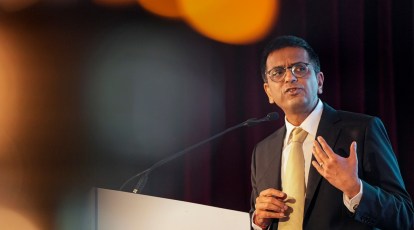 "For every little thing that we do, and believe me, as judges we are no exception to this, for everything that you do, you face the threat of being trolled by someone who does not share your point of view," the CJI said. (PTI)
Chief Justice of India D Y Chandrachud said the Supreme Court of India is not the apex court of Tilak Marg at New Delhi but it represents the aspirations of citizens in the smallest villages in the country
The CJI said today we live in an age where people are short on their patience and tolerance because they are not willing to accept perspectives which are different from their own.
Justice Chandrachud was speaking at the American Bar Association India Conference 2023 here on the theme “Law in the age of Globalisation: Convergence of India and the West”.
The CJI spoke about a range of issues, including technology and its use by the judiciary, especially during the COVID-19 pandemic, issues confronting the judicial profession and on having more women judges.
Truth has become victim in age of false news: CJI Chandrachud
"For every little thing that we do, and believe me, as judges we are no exception to this, for everything that you do, you face the threat of being trolled by someone who does not share your point of view," the CJI said. (PTI)Chief Justice of India D Y Chandrachud said the Supreme Court of India is not the apex court of Tilak Marg at New Delhi but it represents the aspirations of citizens in the smallest villages in the country
Chief Justice of India D Y Chandrachud on Friday said truth has become a “victim” in the age of false news and with the spread of social media, something which is said as a seed germinates into virtually a whole theory that can never be tested on the anvil of rational science.
The CJI said today we live in an age where people are short on their patience and tolerance because they are not willing to accept perspectives which are different from their own.
The CJI spoke about a range of issues, including technology and its use by the judiciary, especially during the COVID-19 pandemic, issues confronting the judicial profession and on having more women judges.
Justice Chandrachud said in many ways, the Indian Constitution is a prime example of globalisation even before we ventured into the age of globalisation.
He said when the Constitution was drafted, its makers had possibly no idea of the lines along which humanity would evolve.
We did not possess notions of privacy, there was no internet. We did not live in a world which was controlled by algorithms. We certainly did not have a social media,” he said.
For every little thing that we do, and believe me, as judges we are no exception to this, for everything that you do, you face the threat of being trolled by someone who does not share your point of view,” the CJI said.
He said just as humanity has expanded with the global advent of travel and technology, humanity also has retreated within by not willing to accept anything that people, as individuals, believe in.
“And I believe that is the challenge of our age. Some of this is perhaps the product of technology itself,” he said, while also dwelling on the positives of technology.
Speaking about the time when COVID-19 had spread across the world, including India, the CJI said the Indian judiciary started video-conferencing in a very gentle way and then expanded it across all courts.
“What video-conferencing has done as a consequence of pandemic is that it has led to a decentralisation of justice. And I think this decentralisation of justice is an important paradigm in promoting greater access to justice,” he said.
He said the Supreme Court of India is not the apex court of Tilak Marg at New Delhi but it represents the aspirations of citizens in the smallest villages in the country.
“And what better way to reach out to our citizens than to use technology as a part of our mission to take justice to the doorsteps of citizens,” he said.
“But, apart from technology, there are vital issues which confront the profession today. Chief among them is the reform of the legal profession itself. In so many ways, our profession is still patriarchal, our profession is feudal, our profession is built upon kinships and relationships of community,” he said.
Justice Chandrachud said globalisation has led to its own discontent and there are a number of reasons for this, for the meltdown which has been experienced the world over.
“One, I think the first of the origins of this lay in the terror attacks which took place in 2001. India was shaken up sporadically by these terror attacks… But 2001 was a watershed moment which brought to the global society the stark realities which India had already confronted for years and years before that,” he said.
The CJI said he is often asked about why we cannot have more women judges in the country.
He said the state of our institution today in terms of inclusion and diversity reflects the state of the profession two decades ago.
Because the judges who come to the high courts today, say in 2023, or judges who come to the Supreme Court in 2023 reflect the state of the bar in the beginning of the millennium,” he said.
Justice Chandrachud said unless there was a level-playing field for women to enter and thrive in the legal profession between 2000 and 2023, there is no magic wand by which you will have apex court judges drawn from among women in 2023.
“So we have to create a framework, a groundwork for a more diverse and inclusive profession today if we truly have to create a future where our profession will be more inclusive and diverse,” he said.
The CJI said the statistics on recent recruitment in the district judiciary in India indicates that in many states, more than 50 per cent are women.
He said the cause of that is the spread of education in India.
“As education spread in India, women education has gone up and there is today a perception on the part of middle class, the growing middle class in India, that the key to prosperity of an average Indian family is to educate their daughters,” he said.
The CJI also gave details of how the Supreme Court has adopted technology, including live-streaming of proceedings of the constitution benches and translation of judgements in regional languages
https://indianexpress.com/article/india/truth-victim-in-age-of-false-news-cji-chandrachud-8478773/
